NEWS
‘What's Up? Media’ Article on Menhaden Fails to Tell Both Sides
WASHINGTON, DC / May 16, 2025
A recent article by Lisa Lewis in What's Up? Media ("The Osprey-Menhaden Bay Connection," 5/16) presents a one-sided perspective that echoes the claims of a well-funded coalition of special interest environmental groups, while ignoring the extensive scientific evidence and stakeholder voices that contradict their narrative. The piece amplifies talking points that have been challenged by federal agencies, independent scientists, and frontline workers in the industry, while repeating several inaccurate claims about the menhaden fishery.
WASHINGTON, DC / May 16, 2025 / A recent article by Lisa Lewis in What's Up? Media ("The Osprey-Menhaden Bay Connection," 5/16) presents a one-sided perspective that echoes the claims of a well-funded coalition of special interest environmental groups, while ignoring the extensive scientific evidence and stakeholder voices that contradict their narrative. The piece amplifies talking points that have been challenged by federal agencies, independent scientists, and frontline workers in the industry, while repeating several inaccurate claims about the menhaden fishery.
The Science Is Clear: Menhaden Are Not Overfished
The article asserts that industrial fishing is to blame for a decline in menhaden abundance in the Bay, while omitting the overwhelming scientific consensus to the contrary. The Atlantic States Marine Fisheries Commission (ASMFC), the agency that manages menhaden for East Coast states, has repeatedly found the stock to be healthy and sustainably managed. According to the Commission's most recent stock assessment, released in 2022, menhaden are not overfished, and overfishing is not occurring.
The fishery operates under Ecological Reference Points, an ecosystem-based management approach that accounts for the needs of predators like striped bass, bluefish, and weakfish. In fact, less than 0.5% of menhaden born each year are harvested. The menhaden fishery is also certified sustainable by the Marine Stewardship Council (MSC), the gold standard for international third-party environmental certification.
USGS and VIMS Question Osprey Diet Claims
The article relies on preliminary findings from a 2024 survey by the Center for Conservation Biology, suggesting menhaden scarcity is causing osprey chick reproduction failure in parts of the Chesapeake Bay. However, it does not mention a recent U.S. Geological Survey (USGS) letter to the House Natural Resources Committee, which responded to congressional questions about the osprey claims.
In its letter, the USGS found no biologically significant change in the proportion of menhaden in osprey diets from 2006 to 2021. Menhaden made up a slightly higher portion of the diet in 2021, and any apparent changes were not statistically significant. The letter explained that many other factors - including adverse weather, nesting density, predator interactions, and prey accessibility - can impact osprey chick survival. It emphasized that striped bass is a key prey species for ospreys in parts of the Bay; striped bass is currently overfished, primarily due to recreational fishing mortality.
Scientists with the Virginia Institute of Marine Science (VIMS) also questioned the purported menhaden-osprey connection in a 2024 peer-reviewed response. VIMS noted that a previous 2023 study on osprey did not establish a causal relationship between menhaden availability and osprey reproduction.
Ocean Harvesters Is a U.S. Company with American Crews
The article claims the fishery is dominated by a "Canadian-owned company," which is wrong. While Omega Protein is part of the international Cooke, Inc. family of companies, the vessels that harvest menhaden are owned and operated by Ocean Harvesters - a U.S.-based, independently owned company with American-flagged vessels and unionized American crews. In 2024, the U.S. Maritime Administration confirmed the company is in full compliance with the American Fisheries Act, which regulates participation by foreign companies in U.S. fisheries.
Omega Protein, based in Reedville, Virginia, processes the fish caught by Ocean Harvesters under a service agreement between the companies. These jobs support rural communities and represent one of the largest unionized workforces in the region.
On Transparency and Collaboration
The article repeats the false claim that Omega Protein refuses to share data with scientists, citing concerns raised by the Chesapeake Bay Foundation's Dr. Allison Colden. This suggestion is simply not true. Confidential landings data from the menhaden reduction fishery is routinely provided to NOAA, the ASMFC, and state regulators-including the Virginia Marine Resources Commission. This data is not casually handed out to competitors or to researchers affiliated with advocacy groups seeking to undermine the fishery; rather, it is shared with official scientific and regulatory bodies responsible for stock assessments and management decisions.
This data is not publicly distributed because it is protected under federal confidentiality laws, just like commercial data from all fisheries. However, it is actively used in the development of all stock assessments, including the Ecological Reference Points that Dr. Colden herself has publicly supported. The entire scientific understanding of the health of the menhaden stock depends on this data. To suggest otherwise is either a misunderstanding of fisheries science or a willful attempt to mislead the public.
In fact, the fishery has supported and participated in more than 15 research projects in collaboration with institutions such as VIMS and NOAA and contributed to the design of the Bay-specific study referenced in the article. Industry critics can't have it both ways-celebrating models built on this data while claiming the data isn't provided.
Reasonable Precautions Are Already in Place
The article accurately notes the Chesapeake Bay harvest cap has been cut repeatedly, from 109,020 metric tons in 2006 to 51,000 metric tons today - a reduction of more than 50%. That cap remains in place today as a precautionary safeguard, not in response to any scientifically derived or observed population decrease necessitating harvest cuts.
Local Economic and Social Contributions
In addition to its ecological and regulatory strengths, the menhaden fishery is a major driver of the local economy in Northumberland County, Virginia. The fishery, primarily operated by Omega Protein and its harvesting partner Ocean Harvesters, generates over $100 million in annual economic activity. If operations ceased, the region would face the loss of over 500 direct and indirect jobs, with Northumberland County bearing the brunt of this impact.
The industry directly employs over 260 individuals and provides an annual payroll and benefits package of approximately $23 million. Fishery workers are represented by the United Food and Commercial Workers Union (UFCW) Local 400, which ensures strong collective bargaining rights, fair wages, and safe working conditions. This makes the menhaden fishery one of the largest union-represented private-sector employers in the region.
Importantly, the fishery is one of Northumberland County's largest minority employers, providing stable, long-term jobs to a historically underrepresented workforce. The industry's community impact extends to local vendors and businesses supported by its operations.
A Note on Media Integrity
It's worth noting that Lisa Lewis's article ends with a telling admission: "Special thanks to Valerie Keefer, Maryland communications & media relations manager, CBF, and Kenny Fletcher, director of communications and media relations, CBF." This acknowledgment makes clear that the story was heavily influenced-if not directly shaped-by the Chesapeake Bay Foundation's communications team. It raises serious questions about the objectivity of the piece, which lacks input from fisheries scientists, union workers, and others with direct knowledge of the fishery. For readers seeking a balanced view of the Chesapeake Bay's most regulated and scrutinized fishery, this article falls short.
One modest but important positive is that Dr. Bryan Watts, quoted throughout the article, acknowledges uncertainty about the cause of reproductive issues in ospreys. This marks a notable shift from his previous public statements, which more definitively attributed the issue to the menhaden fishery. Dr. Watts now says, "We do not know why menhaden have become less available to ospreys," reflecting a more nuanced and scientifically appropriate stance given the complex web of factors at play.
The menhaden fishery is highly regulated, science-based, and a vital part of the Bay's economy. The complex ecology of ospreys, striped bass, and menhaden deserves continued research - and that research should be conducted in good faith, not through premature conclusions or special interest narratives.
About the Menhaden Fisheries Coalition
The Menhaden Fisheries Coalition (MFC) is a collective of menhaden fishermen, related businesses, and supporting industries. Comprised of businesses along the Atlantic and Gulf coasts, the Menhaden Fisheries Coalition conducts media and public outreach on behalf of the menhaden industry to ensure that members of the public, media, and government are informed of important issues, events, and facts about the fishery.

USGS Challenges Simple Narrative Linking Menhaden to Osprey Decline
WASHINGTON, DC / May 5, 2025
A letter from the U.S. Geological Survey (USGS) sent last week to the House Natural Resources Committee indicates multiple environmental stressors - not just prey availability - are responsible for recent osprey reproduction issues in the Chesapeake Bay. The USGS' conclusions challenge narratives pushed by menhaden fishery opponents, including a widely publicized study by Dr. Bryan Watts of the Center for Conservation Biology, which linked a decline in osprey reproduction in Virginia's Mobjack Bay to reduced availability of menhaden.
WASHINGTON, DC / May 5, 2025 / A letter from the U.S. Geological Survey (USGS) sent last week to the House Natural Resources Committee indicates multiple environmental stressors - not just prey availability - are responsible for recent osprey reproduction issues in the Chesapeake Bay. The USGS' conclusions challenge narratives pushed by menhaden fishery opponents, including a widely publicized study by Dr. Bryan Watts of the Center for Conservation Biology, which linked a decline in osprey reproduction in Virginia's Mobjack Bay to reduced availability of menhaden.
Menhaden increase in osprey diets is statistically insignificant
Specifically, the USGS finds that the Watts et al. (2024) study did not demonstrate a biologically significant change in the proportion of menhaden in the osprey diet over time. The agency also noted that menhaden made up a slightly higher portion of the diet in 2021 compared to 2006-07, although the difference is statistically insignificant. "Although the proportion of Menhaden as a percentage of total diet in 2021 is numerically larger than the 2006-07 value, the two values are bounded by overlapping error bars, and are thus not different in a biologically meaningful way," the letter stated.
"The amount of food delivered to young in a nest can be influenced by many factors, including prey abundance, access to prey, … increased predation risk, parental condition, brood size, and adverse weather conditions," said the USGS letter, which was delivered on May 2. "Ecological systems such as this are complex and occur at large scales that make it difficult and sometimes not possible to measure and accurately estimate the influence of all contributing factors."
Chesapeake osprey trends also seen around the country
Following bird conservation measures including the banning of DDT, the Atlantic Coast osprey population increased by nearly 600% between 1966 and 2022. In the Chesapeake Bay, it has increased by about 1800% since 1960. While scientists have observed a leveling off of osprey populations between 2012 and 2022, populations remain high by historical standards. Furthermore, the USGS reports that this trend has been observed in numerous other locations including Florida, South Carolina, North Carolina, and Delaware, as well as the Pacific Coast, raising serious questions about any impact from the menhaden fishery since there is no menhaden fishery in those locations.
Overfished Striped Bass also an important food source for osprey
The USGS also identifies striped bass as an important food source for osprey in parts of the Chesapeake Bay and notes that the status of this stock may influence osprey reproduction. "Preliminary observations made by USGS scientists during a 2024 Osprey nesting study in the vicinity of the Choptank River suggest Menhaden and Striped Bass may be the primary prey type there," the letter states. It further explains that "the principal contributing factor to poor breeding performance was loss of young due to starvation," likely caused by "limited prey capture and/or prey delivery to nests." Additionally, the letter notes that "the USGS has included Striped Bass among the list of prey species captured and consumed by Osprey at some Chesapeake study sites," and concludes that "many of the factors that affect the status of the Striped Bass stock in the Chesapeake could also have direct or indirect effects on Osprey reproduction."
The Atlantic States Marine Fisheries Commission (ASMFC) has found that Atlantic striped bass are currently overfished, with spawning stock biomass below the sustainable threshold as of the most recent assessment. Over the past decade, recreational fishing-particularly in the Chesapeake Bay-has been the primary driver of striped bass mortality, accounting for the vast majority of total removals, including substantial losses from catch-and-release mortality¹. The ASMFC has repeatedly cited recreational release mortality as a major factor in the species' decline² and has responded with new management measures aimed at rebuilding the stock by 2029³. Conversely, the Atlantic menhaden fishery has repeatedly been found to be healthy and sustainably managed. The most recent stock assessment by the Atlantic States Marine Fisheries Commission in 2022 found menhaden is not overfished and overfishing is not occurring. The fishery has been certified sustainable by the Marine Stewardship Council, the gold standard for seafood sustainability, since 2019.
Osprey nesting sites in the Chesapeake are now at a surplus
The USGS scientists reported that the number of breeding pairs in the Chesapeake Bay increased from approximately 1,450 pairs in 1973 to around 10,000 pairs in 2020 - an increase of nearly 600 percent. "All estimates indicate that the density of breeding pairs of Osprey in the Chesapeake has grown substantially since the 1970s," the letter states. It also notes that "there are many natural structures, duck blinds, and manmade platforms suitable for nesting Osprey in the Chesapeake," and that "Osprey nesting sites in the Chesapeake are now at a surplus and unused platforms are frequently being taken over by Canada Geese." While the letter does not conclude that the population has exceeded environmental limits, it acknowledges that "as a natural population regulation process," higher osprey densities increase competition for limited resources such as food and nesting sites, and that "growth usually continues until the population reaches the maximum population size the environment can support."
VIMS also found no clear relationship with menhaden
Last fall, scientists from the Virginia Institute of Marine Science (VIMS) also found that the Watts study did not "establish a clear relationship with menhaden abundance and availability." Both the original Watts study⁴ and the VIMS rebuttal⁵ were published in the journal Frontiers in Marine Science.
The USGS findings make clear that osprey reproduction is shaped by a wide array of environmental factors - and that no single fishery can shoulder the blame. The letter shows that blaming the menhaden fishery for complex ecological trends in osprey populations oversimplifies the science and misleads the public. Moreover, the overfished status of striped bass - driven largely by recreational fishing - may also be a contributing factor.
Footnotes
¹ Atlantic States Marine Fisheries Commission. Atlantic Striped Bass Stock Assessment Update. October 2022.
² Atlantic States Marine Fisheries Commission. Amendment 7 to the Atlantic Striped Bass Interstate Fishery Management Plan. May 2022.
³ Atlantic States Marine Fisheries Commission. Addendum II to Amendment 7. January 2024.
⁴ Watts Bryan D. , Stinson Christine H. , McLean Peter K. , Glass K. Andrew , Academia Michael H. , Byrd Mitchell A. (2023). Prey provisioning and diet of Osprey in lower Chesapeake Bay: A comparative study. Frontiers in Marine Science.
https://www.frontiersin.org/articles/10.3389/fmars.2023.1284462/full
⁵ Latour Robert J. , Gartland James , Ralph Gina M. (2024). Commentary: Prey provisioning and diet of Osprey in lower Chesapeake Bay: A comparative study. Frontiers in Marine Science.
https://www.frontiersin.org/articles/10.3389/fmars.2024.1416687/full
About the Menhaden Fisheries Coalition
The Menhaden Fisheries Coalition (MFC) is a collective of menhaden fishermen, related businesses, and supporting industries. Comprised of businesses along the Atlantic and Gulf coasts, the Menhaden Fisheries Coalition conducts media and public outreach on behalf of the menhaden industry to ensure that members of the public, media, and government are informed of important issues, events, and facts about the fishery.
Union Workers Urge Menhaden Regulators to Reject Environmental Misinformation and Protect Coastal Jobs
WASHINGTON, DC / May 2, 2025
The six shop stewards representing union fishermen members of United Food & Commercial Workers (UFCW) Local 400 are calling on the Atlantic States Marine Fisheries Commission to protect working Virginia watermen and rely on science, not pressure from environmental and sportfishing advocacy groups, in their decisions next week. The call comes in a letter signed by the shop stewards to the Commission's Menhaden Management Board, as the Commission will debate proposals that could threaten fishing jobs and communities.
WASHINGTON, DC / May 2, 2025 / The six shop stewards representing union fishermen members of United Food & Commercial Workers (UFCW) Local 400 are calling on the Atlantic States Marine Fisheries Commission to protect working Virginia watermen and rely on science, not pressure from environmental and sportfishing advocacy groups, in their decisions next week. The call comes in a letter signed by the shop stewards to the Commission's Menhaden Management Board, as the Commission will debate proposals that could threaten fishing jobs and communities.
The Menhaden Fisheries Coalition (MFC) supports these union fishermen, who work for MFC member Ocean Harvesters and whose livelihoods depend on the health of the menhaden fishery.

For generations, these fishermen and their families have sustainably harvested menhaden, and they take pride in fishing in a responsible way. However, they believe that in recent years, their experience, commitment, and voices have been pushed aside.
"Too often during public meetings on fisheries management, the voices of those of us who work directly in the menhaden fishery-and whose livelihoods depend on it-are dismissed as self-serving, and [we are] frequently perceived as the ‘bad guys,'" the fishermen write.
Meanwhile, they observe that environmental groups are often accepted as speaking on behalf of the public, simply because they claim to do so. "Regulators cannot responsibly accept the premise that environmental activist groups speak for the public interest simply because it says so on their website," they state.
The letter points to the Menhaden Chesapeake Bay Work Group as a prime example of this imbalance. The group was formed on the belief that the menhaden fishery is to blame for a decline in osprey fledgling survival, despite the lack of solid scientific backing supporting this claim. The letter also makes clear who is driving that message:
"That should not be a surprise given that members of this working group are led by employees of the Audubon Society and the Chesapeake Bay Foundation (CBF)."
And they argue, their motive is financial.
"These groups depend on contributions and grants that are easier to obtain when they can point to a crisis they claim to be addressing," the letter states, specifically calling out CBF for "fundraising using the osprey ‘crisis,' blaming the menhaden reduction fishery as the sole culprit." The union leaders say this is not honest public-interest work-it is a self-serving fundraising tactic.
The letter also addresses criticism from recreational fishing organizations, drawing a line between working fishermen in the charter fleet and the large national groups behind the attacks.
"We have nothing but sympathy for the charter and for-hire sectors, comprised of hard-working watermen like ourselves. Notably, it is not the working fishermen, but industry organizations like the American Sportfishing Association and the Theodore Roosevelt Conservation Partnership that lead these attacks on us," the fishermen write.
They remind the Board that the science tells a different story, and that recreational overfishing is responsible for recent declines in striped bass. "ASMFC scientists have identified overfishing by recreational anglers-not the menhaden fishery-as the cause of recent striped bass declines."
The letter emphasizes that the menhaden industry has already made significant concessions. Since 2006, Chesapeake Bay harvests have been cut by nearly two-thirds. The fishery also helped develop and implement Ecological Reference Points (ERPs)-a science-based approach to managing menhaden with the needs of the ecosystem in mind. But because ERP implementation didn't result in deeper harvest cuts, they say, the same groups are now moving the goalposts.
"No amount of science or common sense sways these groups from their mission: to put an end to our livelihoods," they write.
They also provide historical context. The closures of past reduction plants had nothing to do with overfishing-they were caused by coastal gentrification, political pressure, and low fish meal and fish oil prices. In fact, during the 1900s, when the reduction fishery operated at much higher harvest levels, "the Chesapeake Bay remained healthy and productive." The real damage came from nutrient loading, wetland loss, and DDT.
Now, with the fishery operating at its lowest levels in modern history, the union fishermen are clear: "We can sustain no further restrictions."
They urge the Menhaden Management Board to rely on the forthcoming guidance of the Menhaden Stock Assessment Subcommittee and the ERP Working Group, and to make decisions grounded in science-not in the manufactured narratives of activist groups.
The letter ends with a plea, asking the board to "recognize the financial and self-serving motivations of those who seek to eliminate our way of life and destroy our historic fishing communities."
About the Menhaden Fisheries Coalition
The Menhaden Fisheries Coalition (MFC) is a collective of menhaden fishermen, related businesses, and supporting industries. Comprised of businesses along the Atlantic and Gulf coasts, the Menhaden Fisheries Coalition conducts media and public outreach on behalf of the menhaden industry to ensure that members of the public, media, and government are informed of important issues, events, and facts about the fishery.
Recent Reporting on New York State Law Misleads on Menhaden Population and Regulations
WASHINGTON, DC / February 14, 2025
An article recently published by Public News Service ("NY's Regulations Help Keep Menhaden Populations High") presents a misleading narrative regarding Atlantic menhaden populations, regulations, and their ecological impact.
WASHINGTON, DC / February 14, 2025 / An article recently published by Public News Service ("NY's Regulations Help Keep Menhaden Populations High") presents a misleading narrative regarding Atlantic menhaden populations, regulations, and their ecological impact.
First, there is no scientific evidence that menhaden populations are declining in the Chesapeake Bay. The article states, "New York's decision to implement stricter menhaden protections in 2020 has led to a resurgence of the fish population," implying that populations were previously in decline. However, the coastwide menhaden stock from Maine to Florida has been in good shape for decades, as confirmed by the Atlantic States Marine Fisheries Commission (ASMFC), which manages the species coastwide. The ASMFC has repeatedly found that the species is not overfished and overfishing is not occurring. Additionally, the Atlantic menhaden fishery has been certified sustainable by the Marine Stewardship Council, the world's preeminent seafood sustainability certification body, since 2019.
Second, there is no evidence that New York's marine ecosystem was suffering due to a supposed menhaden decline in the Chesapeake Bay. The claim that New York's marine ecosystem has improved because of state-level regulation misrepresents how menhaden are managed. Menhaden populations and harvest levels are coordinated by the ASMFC across all Atlantic states, including New York and Virginia, under a shared regulatory framework. The article fails to acknowledge that New York does not have independent ecosystem-based regulations that differ from other states.
John McMurray, president of One More Catch Charters, is correct when quoted in the article as saying, "The Atlantic States Marine Fisheries Commission manages the species for more than just maximum sustainable yield, ensuring enough fish are left in the ocean for predators." However, this is true for all states along the East Coast, not just New York. The ecosystem-based approach to menhaden management was adopted coastwide in 2020, not specifically as a New York initiative.
The article also inaccurately suggests that Virginia lags behind New York in conservation efforts, with Jacqueline Higgins, forage fish manager for the Theodore Roosevelt Conservation Partnership, stating, "We can look at what New York is seeing and anticipate Virginia could see similar results." This assertion is baseless, as menhaden populations have been stable across the Atlantic for years. The claim that Virginia is less proactive ignores the fact that Virginia adheres to the same ASMFC regulations and, in fact, collects more data than any other state due to its role as the largest menhaden harvester.
Furthermore, the suggestion that Virginia's commercial menhaden industry has prevented effective legislation is false. The industry works closely with the Virginia Marine Resources Commission and the ASMFC to ensure sustainable management of the fishery.
Public News Service disclosed that the Theodore Roosevelt Conservation Partnership contributes to their fund for reporting on Climate Change/Air Quality, Endangered Species & Wildlife, Environment, Public Lands/Wilderness.
About the Menhaden Fisheries Coalition
The Menhaden Fisheries Coalition (MFC) is a collective of menhaden fishermen, related businesses, and supporting industries. Comprised of businesses along the Atlantic and Gulf coasts, the Menhaden Fisheries Coalition conducts media and public outreach on behalf of the menhaden industry to ensure that members of the public, media, and government are informed of important issues, events, and facts about the fishery.
State of Maryland Survey Finds Juvenile Menhaden Abundance in the Chesapeake Bay at Highest Level Since 1990 Two Years in a Row
WASHINGTON, DC / December 11, 2024
The Maryland Department of Natural Resources (DNR) has announced findings from its 2024 juvenile striped bass survey, revealing a significant milestone for juvenile menhaden in the Chesapeake Bay. While the survey documented continued challenges for striped bass reproduction, it highlighted a positive trend for two key forage species: menhaden and spot.
WASHINGTON, DC / December 11, 2024 / The Maryland Department of Natural Resources (DNR) has announced findings from its 2024 juvenile striped bass survey, revealing a significant milestone for juvenile menhaden in the Chesapeake Bay. While the survey documented continued challenges for striped bass reproduction, it highlighted a positive trend for two key forage species: menhaden and spot.
"Encouraging results were documented regarding two species lower on the food chain," DNR wrote. "Menhaden abundance was nearly equal to last year, which was the highest measured since 1990. Spot abundance was the highest measured since 1988. These species are vital to the ecology of the Bay as a food source for many other species of fish and wildlife."

The Maryland DNR juvenile striped bass survey monitors the reproductive success of striped bass as well as the abundance of other fish species in the Chesapeake Bay. Biologists conduct the survey three times each summer at 22 sites across the Choptank, Nanticoke, and Potomac rivers, as well as the upper Chesapeake Bay. In 2024, the survey captured more than 56,000 fish of 56 different species.
"As many industry opponents baselessly claim low numbers of menhaden in the Chesapeake Bay, this survey is further evidence that the population remains strong," said Ben Landry, Vice President of Public Affairs at Ocean Fleet Services, an MFC member. "We'll continue to use the best science to guide our fishery, which is sustainable thanks to the collaborative efforts of industry, fishery managers, and scientists."
A full list of species encountered in the survey since 1954, including menhaden, can be accessed on the Maryland Department of Natural Resources website: Juvenile Index: Encountered Species Since 1954.
For more information, visit the Maryland Department of Natural Resources' announcement here: DNR 2024 Survey Results.
The Atlantic menhaden fishery is certified sustainable by the Marine Stewardship Council, the gold standard for seafood sustainability. The Atlantic States Marine Fisheries Commission has repeatedly found that the fishery is not overfished nor experiencing overfishing, most recently in its 2022 stock assessment.
About the Menhaden Fisheries Coalition
The Menhaden Fisheries Coalition (MFC) is a collective of menhaden fishermen, related businesses, and supporting industries. Comprised of businesses along the Atlantic and Gulf coasts, the Menhaden Fisheries Coalition conducts media and public outreach on behalf of the menhaden industry to ensure that members of the public, media, and government are informed of important issues, events, and facts about the fishery.
Gulf Menhaden Population Confirmed Healthy
GULF SHORES, AL / October 17, 2024
The Gulf menhaden fishery continues to be harvesting sustainably and effectively managed, according to a new report by the Gulf States Marine Fisheries Commission (GSMFC). Approved by the GSMFC at its annual meeting this week, the 2024 Update to the Gulf of Mexico Menhaden Stock Assessment once again confirms that the Gulf menhaden stock is neither overfished nor experiencing overfishing.
GULF SHORES, AL / October 17, 2024 / The Gulf menhaden fishery continues to be harvesting sustainably and effectively managed, according to a new report by the Gulf States Marine Fisheries Commission (GSMFC). Approved by the GSMFC at its annual meeting this week, the 2024 Update to the Gulf of Mexico Menhaden Stock Assessment once again confirms that the Gulf menhaden stock is neither overfished nor experiencing overfishing.
The updated stock assessment includes new data from 2021 to 2023, the years since the last Gulf menhaden assessment was completed in 2021. In addition to its primary conclusion showing no overfishing, the assessment has positive news for several other key metrics of the stock's health. Spawning stock biomass (the combined weight of all fish capable of reproducing) has continued to rise steadily since the 1990s and remains at a high, sustainable level. Fishing mortality rates decreased in the 1990s and 2000s and have remained at lower levels ever since.

Gulf menhaden spawning stock biomass. Source: Gulf States Marine Fisheries Commission
"The results of this assessment reaffirm the responsible and effective management of the Gulf menhaden fishery, and its long-term sustainability," said Ben Landry, Vice President of Public Affairs for Ocean Fleet Services, a Menhaden Fisheries Coalition member. "Our industry is committed to maintaining healthy fish populations, and this assessment highlights the success of the collaborative efforts of industry, scientists, and fishery managers."
Highlights of the assessment include:
Increased spawning stock biomass: Gulf menhaden has shown consistent growth in its reproductive capacity over the past three decades;
Low fishing mortality rates: Fishing pressure has remained at reduced levels, ensuring the fishery's sustainability;
Stock health remains strong: The Gulf menhaden stock is not overfished, nor is it experiencing overfishing, as confirmed by the Beaufort Assessment Model (BAM), the statistical catch-age model used in the assessment. Additional sensitivity analyses and Monte Carlo bootstrap ensemble runs (MCBEs) were also completed.

Gulf menhaden fishing mortality. Source: Gulf States Marine Fisheries Commission
The two previous assessments, released in 2021 and 2018, similarly concluded that the stock was healthy, that there was no overfishing, and that overfishing was not occurring. Since 2019, the Gulf menhaden fishery has been certified as sustainable by the Marine Stewardship Council, one of the most rigorous and recognizable sustainability certifications in the world.
The GSMFC's Menhaden Advisory Committee has recommended the next operational assessment be conducted in 2027, unless significant new data warrants review before then.
For more information about the Gulf menhaden fishery and the Menhaden Fisheries Coalition, please visit www.menhaden.org.
About the Menhaden Fisheries Coalition
The Menhaden Fisheries Coalition (MFC) is a collective of menhaden fishermen, related businesses, and supporting industries. Comprised of businesses along the Atlantic and Gulf coasts, the Menhaden Fisheries Coalition conducts media and public outreach on behalf of the menhaden industry to ensure that members of the public, media, and government are informed of important issues, events, and facts about the fishery.
Menhaden Fisheries Coalition and Virginia Waterman's Association Thank Governor Youngkin for Declaring "Commercial Waterman Safety Week" in Response to Growing Threats
WASHINGTON, DC / September 18, 2024
Virginia Governor Glenn Youngkin has declared this week, September 15-21, 2024, "Commercial Waterman Safety Week." The governor's proclamation recognizes that Virginia's more than 1,500 commercial watermen "risk their lives sustaining a tradition passed down through generations," help generate over $1 billion in economic impact for the Commonwealth, and deserve "access to a secure and safe work environment."
WASHINGTON, DC / September 18, 2024 / Virginia Governor Glenn Youngkin has declared this week, September 15-21, 2024, "Commercial Waterman Safety Week." The governor's proclamation recognizes that Virginia's more than 1,500 commercial watermen "risk their lives sustaining a tradition passed down through generations," help generate over $1 billion in economic impact for the Commonwealth, and deserve "access to a secure and safe work environment."
The Menhaden Fisheries Coalition and the Virginia Waterman's Association are grateful to Governor Youngkin for recognizing the vital role of Virginia watermen, including menhaden fishermen and watermen harvesting crabs, oysters, clams, fish, and other shellfish. Governor Youngkin has taken important steps to ensure Virginia's fishermen and watermen have a safe place to work on the water.
Earlier this year, increasing threats and acts of harassment directed towards commercial fishermen operating in Virginia waters led the governor to sign the "Right to Fish" law, which raises penalties for those who interfere with or impede commercial watermen. This legislation was overwhelmingly approved by the General Assembly, passing the Virginia House 99-0 and the Virginia Senate 38-1.
"We put something on the books that said we are going to protect and defend the industry and its people," said Delegate Hillary Pugh Kent, the legislation's primary sponsor, in a Menhaden Fisheries Coalition video. "It's a worker safety bill."
The most notable incident that led to the "Right to Fish" law occurred nearly a year ago. On September 23, 2023, menhaden fishermen working for Ocean Harvesters were accosted by an individual on a jet ski, who harassed the crew as they operated a pair of menhaden purse vessels. The individual drove his jet ski inside the purse seine net connecting the two vessels, yelling profanities and threats at the Ocean Harvesters workers, before speeding out of the net right before it closed. This was the third such incident of targeted harassment on the water during the late summer months of 2023. It also came amid increasing threats to commercial menhaden fishermen on social media.
The Atlantic menhaden fishery has operated continuously in Virginia for over 100 years. It has repeatedly been found to be a sustainable fishery. The most recent stock assessment from the Atlantic States Marine Fisheries Commission found that menhaden are not overfished and overfishing is not occurring. An analysis by the Science Center for Maine Fisheries found that 99.5 percent of menhaden born each year are left in the water to fulfill their ecological role. The fishery has been certified sustainable by the Marine Stewardship Council, the world's foremost seafood sustainability certification body.
Virginia watermen are a diverse group of hardworking individuals who make their living from the waters of the Chesapeake Bay, its tributaries, and the coastal areas of Virginia. These watermen are deeply connected to the traditions and culture of commercial fishing, often coming from families that have worked the waters for generations. They harvest a wide range of seafood, including crabs, oysters, clams, and fish, employing time-honored methods alongside modern practices. The watermen are dedicated stewards of the environment, relying on the health of the waterways for their livelihoods, and they work in challenging and often dangerous conditions.
About the Virginia Waterman's Association
The Virginia Waterman's Association represents commercial fishermen in Virginia who work in the state's various waterways, including the Chesapeake Bay, its rivers, and coastal waters. These fishermen typically engage in harvesting a variety of seafood, such as crabs, oysters, clams, fish, and other shellfish. The association advocates for the rights, interests, and sustainability of these watermen, particularly focusing on issues like fisheries management, environmental conservation, and regulations that affect the livelihoods of commercial fishermen in the region.
About the Menhaden Fisheries Coalition
The Menhaden Fisheries Coalition (MFC) is a collective of menhaden fishermen, related businesses, and supporting industries. Comprised of businesses along the Atlantic and Gulf coasts, the Menhaden Fisheries Coalition conducts media and public outreach on behalf of the menhaden industry to ensure that members of the public, media, and government are informed of important issues, events, and facts about the fishery.
U.S. Geological Survey Presentation Raises Questions About Osprey-Menhaden Link Allegations
WASHINGTON, DC / August 7, 2024
Today at the Atlantic States Marine Fisheries Commission (ASMFC) summer meeting, the Menhaden Management Board heard a presentation on osprey populations from U.S. Geological Survey (USGS) scientists; considered but did not agree to a motion to start an addendum on additional commercial menhaden fishing restrictions in the Chesapeake Bay; and ultimately agreed, as a compromise, to create a working group to "consider and evaluate options for further precautionary management of Chesapeake Bay menhaden fisheries."
WASHINGTON, DC / August 7, 2024 / Today at the Atlantic States Marine Fisheries Commission (ASMFC) summer meeting, the Menhaden Management Board heard a presentation on osprey populations from U.S. Geological Survey (USGS) scientists; considered but did not agree to a motion to start an addendum on additional commercial menhaden fishing restrictions in the Chesapeake Bay; and ultimately agreed, as a compromise, to create a working group to "consider and evaluate options for further precautionary management of Chesapeake Bay menhaden fisheries."
The Chesapeake Bay Foundation (CBF) has issued a stunningly deceptive press release, mischaracterizing the tone of today's ASMFC meeting and the action taken there. The CBF release suggests that the material presented by USGS overwhelmingly indicated a problem with osprey in the Chesapeake Bay, and that there was overwhelming support by ASMFC commissioners for additional regulation of menhaden in the Chesapeake Bay. Neither is true. The Menhaden Fisheries Coalition is issuing this release, together with the full audio of the meeting, to clarify the record. The full audio is available here.
Dr. Barnett Rattner and David Ziolkowski of the U.S. Geological Survey gave a presentation on the health of osprey populations from coast to coast. Mr. Ziolkowski noted that "in North America in the 1950s and 60s, osprey population started declining rapidly due to the effects of volcanic chlorine, pesticides like DDT, and it's estimated that the Chesapeake Bay probably lost about half or more of its population."
However, Mr. Ziolkowski explained that after measures were taken, including banning DDT, between 1966 and 2022, the eastern population of osprey increased by about 300%, and the Atlantic Coast population increased by about 587%. In the Chesapeake Bay it's increased by about 1800% since 1960. He continued, "…what these numbers bear out is that osprey have made an astounding recovery by all accounts. The numbers are now in excess of historical numbers and in part that's because they've returned to a world that's very different than the world was before they started declining. There's more suitable nesting structures. Water may be cleaner, et cetera."
Mr. Ziolkowski did note that during the period from 2012 to 2022, "something's going on," as there has been a leveling off in the growth of the osprey populations in the mid-Atlantic. But he explained, "Care must be used when you're interpreting these kinds of results and to understand what I mean, it's helpful to look at osprey trends across the country. So here I'll point out three things that I hope you take notice of in these graphs. On the left-hand side here, for example, California and Washington, opposite coast, you can see that there's something going on in the same time period as there is here in Maryland, Virginia."
During the Q&A following the presentation, Commissioner Patrick Geer of Virginia, Chief of Fisheries Management at the Virginia Marine Resources Commission, noted that "Dr. [Bryan] Watts has done a survey in Virginia, for a number of years, going back to I believe 1993, which has shown the double crested cormorant population has increased 1416% in 25 years and brown pelicans have been about 882%. Now those species that are primarily piscivores…they're competing for the same food source…Maybe the [osprey] nests aren't surviving, maybe they're moving out and these two species are moving in? Is that possible?" To which Dr. Rattner replied "Yes, it's possible, certainly."

Dr. Barnett Rattner and David Ziolkowski of the U.S. Geological Survey present a slide to the Menhaden Management Board showing that the recent leveling-off in Maryland and Virginia osprey populations, after years of explosive growth, is a phenomenon also being seen in states across the nation, on both the East and West Coast.
After the presentation by the USGS scientists, Commissioner Lynn Waller Fegley of Maryland, Director of Fishing and Boating Services at the Maryland Department of Natural Resources, made a motion to initiate an addendum to the Atlantic Menhaden Interstate Fishery Management Plan to consider Chesapeake Bay-specific management options for menhaden purse seine vessels larger than 300 gross tons in order to support the need of piscivorous birds and fish during critical points of their life cycle, and include options for seasonal closures of Chesapeake Bay waters, but not consider changes to the current Bay cap of 51,000 metric tons.
It became immediately apparent that the board was divided on this proposal.
The provision targeting purse seine vessels over 300 tons was obviously included to target the commercial menhaden reduction fishery, which in Virginia is operated by Ocean Harvesters and supplies menhaden to Reedville-based processer Omega Protein. This was questioned by Commissioner Proxy Eric Reid of Rhode Island, who asked if the motion wasn't inherently flawed, since although there are carrier vessels over 300 tons, those vessels get their fish from pairs of small purse seine boats, meaning that the motion accomplished nothing. Mr. Reid's conjecture was confirmed by a member of the delegation from Virginia.
Commissioner Proxy Nichola Meserve of Massachusetts, Fishery Policy Analyst at the Massachusetts Division of Marine Fisheries, raised concerns about "diving immediately into an addendum process," noting that other addenda in the past began "with a work group, a board work group that discussed the issues and the concerns that developed potential strategies.
After much procedural wrangling, there were two votes to postpone action on the motion, one until the October meeting and another indefinitely. Both of those votes tied 9-9. When it became apparent that the motion to initiate an addendum had reached a stalemate, Commissioner Proxy Dr. Allison Colden, Chesapeake Bay Foundation Maryland Executive Director, offered a substitute motion "to establish a board work group to consider and evaluate options for further precautionary management of Chesapeake Bay menhaden fisheries, including time and area closures, to be protective of piscivorous birds and fish during critical points of their life cycle.
The board members accepted this compromise unanimously by acclamation, without a roll call, and the working group is expected to report the results of their discussion to the Menhaden Management Board at its October 2024 meeting.
"Those attending the ASMFC's Menhaden Management Board meeting in person or listening online could only come away with one clear message from the respected researchers at USGS, and that is the osprey's numbers have dramatically increased and any challenges that the seabirds face are complex and multi-faceted, occurring in numerous locations on both the Atlantic and Pacific coasts, and cannot be blamed on the menhaden harvest in the Chesapeake Bay," stated Ben Landry, Vice President of Public Affairs for Ocean Fleet Services and spokesperson for Ocean Harvesters. "To state otherwise is wholly dishonest, but that is commonplace for the Chesapeake Bay Foundation and its decades-long history of false and hyperbolic statements on menhaden fisheries."
The menhaden fishery has long been attacked by those who refuse to accept the science-based conclusions of respected government agencies and independent assessment bodies. However, it is important to remember that since 2020, after athree-year, peer-reviewed effort, with input from both industry and environmental conservation groups, menhaden has been managed using ecological reference points that account for menhaden's role as a forage fish throughout its range.
When the ecological reference points were adopted, Chesapeake Bay Foundation President William C. Baker stated in a release: "This is a historic day for fisheries management. Menhaden have been called the most important fish in the sea for good reason. Menhaden are an essential part of the diet of numerous fish species including striped bass, along with dolphins, whales, osprey and other seabirds."
In 2020, Chris Moore, Senior Regional Ecosystem Scientist for CBF, wrote in the Bay Journal, "Striped bass, of all the predators studied, were shown to be the most sensitive to changes in the menhaden population. Therefore, adopting ecological reference points that protect striped bass will also protect other predator species that rely less on menhaden."
Additionally:
In 2022, the Atlantic States Marine Fisheries Commission concluded there was no evidence that menhaden were being overfished along the Atlantic coast.
The Marine Stewardship Council in 2019 certified the Atlantic menhaden fishery as sustainable.
About the Menhaden Fisheries Coalition
The Menhaden Fisheries Coalition (MFC) is a collective of menhaden fishermen, related businesses, and supporting industries. Comprised of businesses along the Atlantic and Gulf coasts, the Menhaden Fisheries Coalition conducts media and public outreach on behalf of the menhaden industry to ensure that members of the public, media, and government are informed of important issues, events, and facts about the fishery.
US Maritime Administration Tells Undercurrent News That Cooke Menhaden Supplier Is 'In Compliance' With Foreign Ownership Law
WASHINGTON, DC / June 10, 2024
In a story published Friday, Jason Smith of Undercurrent News reported that the US Maritime Administration (MARAD), the chief regulator for enforcing foreign ownership rules in US menhaden fisheries, cleared Omega Protein's menhaden supplier of any wrongdoing in a 2020 investigation.
WASHINGTON, DC / June 10, 2024 / In a story published Friday, Jason Smith of Undercurrent News reported that the US Maritime Administration (MARAD), the chief regulator for enforcing foreign ownership rules in US menhaden fisheries, cleared Omega Protein's menhaden supplier of any wrongdoing in a 2020 investigation.
A lawsuit filed in June 2021 by plaintiffs W. Benson Chiles and Chris Manthey in the US District Court for the Southern District of New York, and unsealed on April 23, 2024, alleges that Cooke Inc., its menhaden-processing subsidiary Omega Protein, and Alpha VesselCo. (operating as "Ocean Harvesters") were violating the American Fisheries Act (AFA). Ocean Harvesters harvests menhaden and supplies the fish to Omega Protein.
According to Undercurrent News, Thomas Johnson, a MARAD spokesperson, stated that Chiles and Manthey had filed a complaint with the agency on December 9, 2020. The complaint accused Alpha Vessel Co. of violating AFA provisions that prevent non-US citizens from exercising "impermissible control" over US fishing vessels.
MARAD reviewed Alpha Vessel Co.'s documentation in 2020 and "found it to be satisfactory and in compliance with fishery endorsement requirements." The company remains "in compliance," said Johnson, as reported by Undercurrent News.
Undercurrent News reports that Plaintiff Benson Chiles is a "strategic consultant for conservation organizations," and has "worked with advocacy groups such as Earthjustice and the Environmental Defense Fund."
In March, the US government declined to join Chiles' and Manthey's lawsuit as an intervenor.
The Atlantic and Gulf menhaden fisheries are certified sustainable by the Marine Stewardship Council.
About the Menhaden Fisheries Coalition
The Menhaden Fisheries Coalition (MFC) is a collective of menhaden fishermen, related businesses, and supporting industries. Comprised of businesses along the Atlantic and Gulf coasts, the Menhaden Fisheries Coalition conducts media and public outreach on behalf of the menhaden industry to ensure that members of the public, media, and government are informed of important issues, events, and facts about the fishery.
Virginia Governor Youngkin Signs Law Protecting Watermen from Harassment
REEDVILLE, VA / April 9, 2024
Delegate Hillary Pugh Kent, representing Virginia's Northern Neck and Caroline County in House District 67, has announced that Governor Glenn Youngkin has signed into law "The Right to Fish" bill, to protect commercial watermen from interference, which she sponsored.
REEDVILLE, VA / April 9, 2024 / Delegate Hillary Pugh Kent, representing Virginia's Northern Neck and Caroline County in House District 67, has announced that Governor Glenn Youngkin has signed into law "The Right to Fish" bill, to protect commercial watermen from interference, which she sponsored.
According to Delegate Kent, "House Bill 928, a bill to protect commercial watermen while they are working in Virginia waters, was signed by Governor Youngkin last week. This bill recognizes the importance of our state's seafood industry by creating protections for commercial watermen and deterring unlawful interference. This new law will provide restitution against those who purposefully inhibit fishing and destroy the property of commercial watermen. It will reinforce the continued viability of our fishing and seafood industries, which are necessary to the economic and cultural fabric of the Northern Neck and all of the Commonwealth."
The legislation adds a new section to the Virginia code addressing interference with commercial fishing vessels or activity. It makes knowingly and intentionally interfering with or impeding commercial fishing activity within Virginia waters a Class 1 misdemeanor. The legislation also imposes penalties such as ineligibility for certain hunting and fishing licenses for varying periods depending on the number of offenses committed. Additionally, individuals convicted of violating this section may be required to complete boating safety education.

Delegate Hillary Pugh Kent with Governor Glenn Youngkin at the signing of House Bill 928. Source: Delegate Hillary Pugh Kent
The bill passed the Virginia House by a unanimous vote of 99-0, and the Senate with only one dissenting vote 38-1.
The Menhaden Fisheries Coalition thanks Delegate Kent and Governor Glenn Youngkin, as well as Delegate Robert S. Bloxom, Jr., who filed similar legislation, House Courts of Justice Chair Patrick A. Hope, House Courts of Justice Criminal Subcommittee Chair Vivian E. Watts, Majority Leader and Senate Courts of Justice Committee Chair Scott Surovell, Senator Richard H. Stuart, Delegate Destiny LeVere Bolling, the bipartisan coalition of copatrons who lent their sponsorship to the bill, and all of the members of the Virginia House of Delegates and Senate who voted for passage.
We would also like to thank the Virginia Manufacturer's Association, the Virginia Watermen's Association, and United Food & Commercial Workers Local 400 for supporting this important and needed legislation.
The new law was proposed in response to an uptick in threats and acts of harassment directed towards commercial fishermen lawfully operating in Virginia's waters.
Instances of dangerous encounters have been escalating in frequency and intensity, threatening physical harm and jeopardizing the safety of our commercial watermen. These confrontations, often involving jet skis and recreational boats, pose risks to all parties involved. Previous statutes imposed only minor penalties, such as nominal fines, which proved insufficient to deter individuals who possess the financial means to own and operate recreational watercraft.
One such incident occurred on September 23, 2023, approximately 1.5 miles east of Buckroe Beach off Hampton. As they were deploying their net, an Ocean Harvesters vessel, the Rappahannock, was accosted by a jet ski operator who harassed the crew as they operated the smaller purse vessels. The individual recklessly drove his jet ski inside the net, doused the crew with his wake, and hurled profanities, including threatening language.
Because there had been a recent history of social media posts threatening potential violence, the incident prompted concern among the Rappahannock crew that the perpetrator might be armed and inclined to escalate the situation. These events were visible and recorded by a spotter pilot operating in coordination with the Rappahannock.
This marked the third occurrence of such incidents during the late summer months of 2023.
Although it is individuals who executed these attacks, they are incited and emboldened by the rhetoric from various sport fishing organizations. These associations meticulously track and disclose the whereabouts of commercial vessels and their anchoring locations each evening. While not directly encouraging their members to disrupt and harass fishing operations, they consistently provided the information needed to do so.
The jet ski incident was promptly reported to both the United States Coast Guard and the Virginia Marine Resources Commission (VMRC). Subsequently, the VMRC investigated the matter. However, due to a lack of commitment from local prosecutors to pursue the case, it was handled as a VMRC offense. The perpetrator pleaded guilty and was fined $500, then boasted about his actions on social media, displaying no remorse.
Some of the threats made online include:
1. "Navy should use them for target practice."
2. "Sink them and blame it on Putin. Need to do like they do on Whale Wars."
3. "Fire the cannons."
4. "Starting to wonder if we can't do some Whale Wars type stuff to these guys."
5. "We need Greenpeace to harass them. Or attack submarines."
6. "Where's the Sea Shepherd… Get the prop fouler out. It can't be that illegal to mess with them."
7. "I have several rifles with scopes and suppression. If someone is a better shot than me, you're welcome to borrow them to sever the net ropes."
8. "It's going to take an organization such as Sea Shepherd in order to wake this state up into action. …Now I know why Capt. Paul took matters into his own hands on Whale Wars."
9. "You got whale war, it's time for menhaden war."
10. "Yeah, I'd love to do a local 'Sea Shepherd' operation on these fools. Jet skis with prop foulers, etc."
11. "Where is the Sea Shepherd when you need it?"
12. "Where's an errant WWII German U-Boat when you really need one…? I've got a small boat and plenty of bottle rockets."
13. "Unfortunately, there's not much that can be done, at least non-violently."
About the Menhaden Fisheries Coalition
The Menhaden Fisheries Coalition (MFC) is a collective of menhaden fishermen, related businesses, and supporting industries. Comprised of businesses along the Atlantic and Gulf coasts, the Menhaden Fisheries Coalition conducts media and public outreach on behalf of the menhaden industry to ensure that members of the public, media, and government are informed of important issues, events, and facts about the fishery.
Virginia Legislature Subcommittee Acts Favorably on Bill to Combat Threats and Interference with Commercial Fishing Vessels
RICHMOND, VA / February 2, 2024
The Virginia House of Delegates Courts of Justice - Criminal Subcommittee, has favorably reported HB 928, legislation to protect commercial watermen, by a unanimous, bipartisan vote of 8-0.
RICHMOND, VA / February 2, 2024 / The Virginia House of Delegates Courts of Justice - Criminal Subcommittee, has favorably reported HB 928, legislation to protect commercial watermen, by a unanimous, bipartisan vote of 8-0.
In response to a rising number of threats and at-sea harassment targeting commercial fishermen operating legally in Virginia waters, two bills were introduced in the 2024 Virginia legislative session. The bills, from Delegate Hillary Pugh Kent and Delegate Robert S. Bloxom, Jr. would increase the penalties for intentionally interfering with commercial fishing operations. Today Delegate Kent's bill was considered, amended, and passed by the subcommittee. The bill increases penalties to a Class 1 misdemeanor which is confinement in jail for not more than twelve months and a fine of not more than $2,500, either or both. Additionally, anyone convicted will forfeit hunting and fishing licenses for one year on first offense, and three years on a second offense.
Dangerous incidents are growing in number and aggression and physical injury, and the lives of union-member, commercial fishermen are being increasingly threatened. These hazardous confrontations have been conducted on jet skis and with recreational boats, endangering all involved. Current law provides for minor penalties, like small fines, which are an insufficient deterrent to individuals with the financial means to own and operate recreational watercraft.
One example occurred on September 23, 2023, approximately 1.5 miles east of Buckroe Beach off Hampton. An Ocean Harvesters vessel, the Rappahannock , was deploying its net when a man on a jet ski overtook them, harassed the fishermen while they were in the smaller purse vessels, rode his jet ski inside the net, sprayed the crew with his wake, and yelled obscenities at them, including "how do you like this m****f***ers." In light of threats posted on social media, the crew of the Rappahannock feared the operator might be armed and could start shooting. Video of the incidentwas taken from the spotter plane operating in tandem with the Rappahannock .

Photo from video of a jet ski harassing commercial watermen on September 23, 2023
This was the third incident of this type which occurred during the late summer months of last year.
While it is individuals who are carrying out these attacks, they are being instigated and fueled by the rhetoric of participants in various sport fishing organizations. These groups monitor and report where commercial boats are operating and where they are anchoring each evening, which appears to have encouraged their membership to harass and disrupt fishing operations.
Some of the threats made online include:
"Navy should use them for target practice."
"Sink them and blame it on Putin. Need to do like they do on Whale Wars."
"Fire the cannons."
"Starting to wonder if we can't do some Whale Wars type stuff to these guys."
"We need Greenpeace to harass them. Or attack submarines."
"Where's the Sea Shepherd… Get the prop fouler out. It can't be that illegal to mess with them."
"I have several rifles with scopes and suppression. If someone is a better shot than me, you're welcome to borrow them to sever the net ropes."
"It's going to take an organization such as Sea Shepherd in order to wake this state up into action. …Now I know why Capt. Paul took matters into his own hands on Whale Wars."
"You got whale war, it's time for menhaden war."
"Yeah, I'd love to do a local 'Sea Shepherd' operation on these fools. Jet skis with prop foulers, etc."
"Where is the Sea Shepherd when you need it?"
"Where's an errant WWII German U-Boat when you really need one…? I've got a small boat and plenty of bottle rockets."
"Unfortunately, there's not much that can be done, at least non-violently."
Menhaden Fisheries Coalition Corrects Misleading Statements from Chesapeake Legal Alliance and Southern Maryland Recreational Fishing Organization
REEDVILLE, VA / December 21, 2023
The Menhaden Fisheries Coalition addresses five inaccurate and misleading statements made in a recent press release by the Chesapeake Legal Alliance and the Southern Maryland Recreational Fishing Organization regarding their petition for rulemaking to the Virginia Marine Resources Commission (VMRC). A brief overview of inaccuracies, expert statements, and scientific findings is listed below, followed by a more detailed discussion of each false claim.
REEDVILLE, VA / December 21, 2023 / The Menhaden Fisheries Coalition addresses five inaccurate and misleading statements made in a recent press release by the Chesapeake Legal Alliance and the Southern Maryland Recreational Fishing Organization regarding their petition for rulemaking to the Virginia Marine Resources Commission (VMRC). A brief overview of inaccuracies, expert statements, and scientific findings is listed below, followed by a more detailed discussion of each false claim.
Factual Inaccuracies:
Menhaden Population:
CLA Claim: Menhaden populations in the Bay are declining.
Coalition Response: Current scientific data does not support the claim of a decline in the portion of the coast-wide menhaden stock in the Bay. The stock assessments indicate a stable and healthy population.
Overfishing and Ecosystem Impact:
CLA Claim: Overfishing of menhaden is causing declines in sportfish, osprey, marine mammals, and diet shifts.
Coalition Response: This statement is contradicted by evidence. Menhaden is neither overfished nor is overfishing occurring. The issue with striped bass, as addressed in the 2022 Atlantic Striped Bass Stock Assessment Update, is primarily due to historic overfishing by the recreational community, not menhaden fishing.
Striped Bass Fishing Moratoria:
CLA Claim: Dire conditions are leading to considerations of moratoria on striped bass fishing seasons.
Coalition Response: Ending menhaden fishing is not a solution for striped bass recovery. Other factors significantly impact striped bass populations, and this approach oversimplifies the issue.
VMRC's Approach to Reduction Fishery:
CLA Claim: VMRC has failed to restrict the reduction fishery, allowing maximum harvests.
Coalition Response: VMRC has adhered to ASMFC guidelines, opting for a conservative, precautionary harvest limit rather than the maximum allowable. This approach reflects responsible and cautious management.
Data Reliability:
CLA Claim: Outdated and unreliable data are used for fisheries regulations.
Coalition Response: The data utilized by ASMFC, surveys, and assessments are current, reliable, and validated by the scientific community. These are considered state of the art and the ASMFC is the first body to use ecosystem-based management in the United States. The science is not considered outdated or unreliable except by specific advocacy groups.
Authoritative Statements and Assessments:
Atlantic States Marine Fisheries Commission: "The ERP assessment ... is an ecosystem model that focuses on four key predator species (striped bass, bluefish, weakfish, and spiny dogfish) and three key prey species (Atlantic menhaden, Atlantic herring, and bay anchovy). ... Under the ERPs, Atlantic menhaden are neither overfished nor experiencing overfishing."(ASMFC website)
Dr. Robert Latour, Chair, Menhaden Management Advisory Committee, VMRC: "You've heard a lot about localized depletion...in my opinion are speculative at best." (Public meeting, December 6, 2022)
Shanna Madsen, Deputy Chief of Fisheries Management, VMRC: "Actually a much more conservative management than we often times use for managing other species, in the name of guarding the ecosystem." (Public meeting, December 6, 2022)
Pat Geer, Chief of Fisheries Management, VMRC: "Even if we stop menhaden fishing altogether in Virginia, striped bass will not recover." (Public meeting, December 6, 2022)
Joseph Gordon & Aaron Kornbluth, Pew Trusts: "…the Atlantic States Marine Fisheries Commission…unanimously [adopted] a system under which catch limits on [menhaden] will account for the needs of its predators and the broader health of the environment. The East Coast's largest fishery is now one of the world's foremost examples of modern, ecosystem-based management in action." (Press Release, August 5, 2020)
Whit Fosburgh, Theodore Roosevelt Conservation Partnership: The adoption of Ecological Reference Points "will spur healthier menhaden and gamefish while supporting the recreational fishing economy along the eastern seaboard." (Press Release, August 5, 2020)
Mike Leonard, American Sportfishing Association: "A healthy Atlantic menhaden stock, and quotas that account for the needs of predators, is the science-based management we look for to help support a healthy ecosystem and the sportfishing opportunities it provides." (Press Release, August 5, 2020)
Scientific Findings:
February 2020 and August 2022 Assessments: The ASMFC Atlantic Menhaden Board accepted results from Single-Species and Ecological Reference Point Assessments. These assessments confirmed that menhaden are neither overfished nor experiencing overfishing, with a healthy reproductive capacity and sustainable fishing mortality rates.
Chesapeake Bay Program Workshop, 2014: A comprehensive study showed that Bay predators consume a wide array of forage items, with many species more prevalent than menhaden.
Annual Surveys: Coastal menhaden stock assessments, including Chesapeake Bay surveys, reveal consistent young menhaden abundance, with no signs of decreasing trends.
Detailed Discussion
In August 2020, the Atlantic States Marine Fisheries Commission voted to alter management strategies for Atlantic menhaden, by requiring consideration for the ecological role that menhaden play in the food chain. The Commission adopted the ecological management system, which considers the needs of predator species. Menhaden is the first fishery on the east coast to shift to an ecosystem management approach.
As noted above, when the Atlantic States Marine Fisheries Commission adopted these Ecological Reference Points (ERPs), both recreational fishing interests and the environmental activist community initially praised the decision. However, once the science behind these ecological reference points was applied in practice, and it was determined that menhaden fishing levels already left sufficient menhaden in the water for prey, these groups changed their tune.
Having failed to use ERPs against the commercial menhaden fishery, they reverted to the hyperbolic accusations of the past, and efforts in opposition to the commercial menhaden fishery, and the jobs and economic benefits it provides began anew.
Unable to blame the low biomass of striped bass on a lack of menhaden, rather than on the recreational overfishing that caused it, many in the recreational community have ignored the facts and scientific determinations. They have reverted to the disproven arguments holding menhaden availability to blame.
Meanwhile, the environmental activist community has turned their focus to birds of prey, specifically the osprey. Recently they have made claims that any real or perceived problems with the osprey population or reproduction are due to a lack of available menhaden, because of the existence of the commercial menhaden fishery. It's the same script, but with a different protagonist.
1. Menhaden Population Decline Claim:
"The best available science shows that menhaden populations in the Bay are in decline."
Contrary to this claim, no scientific evidence indicates that portion of the coast-wide menhaden stock in the Bay is declining.
The theory of a population decline in the Bay, in the absence of a coast-wide decline, is termed "localized depletion." Dr. Robert Latour, Professor of Marine Science at the Virginia Institute of Marine Science, College of William & Mary, and Chairman of the Menhaden Management Advisory Committee at the VMRC, addressed this topic at a VMRC public meeting on December 6, 2022:
"You've heard a lot about localized depletion, I will say for the record, I do not believe we can show that that has happened, and we do not have the data to show that that has happened. There are three things that you need. One is an estimate of abundance in the Bay, a residence time of those fish in the Bay, and movements between the Bay and the near coastal zone, and all three of those things are absent from the data sources that are available to us. So, any comments regarding localized depletion, in my opinion are speculative at best."
2. Overfishing and Ecosystem Impact Claim:
"As overfishing of menhaden continues, there is a strong and direct correlation with declines in the population of sportfish, osprey, and marine mammals, along with forced shifts in diet away from their primary food source of menhaden."
This statement is not accurate. Menhaden has not been overfished for more than two decades, and overfishing is not currently occurring.
The Atlantic States Marine Fisheries Commission's statement on menhaden abundance reads:
"In February 2020, the [Atlantic menhaden] Board accepted the results of the Atlantic Menhaden Single-Species and Ecological Reference Point (ERP) Assessments and Peer Review Reports for management use. The single-species assessment acts as a traditional stock assessment using the Beaufort Assessment Model (BAM), and indicates the stock is not overfished or experiencing overfishing relative to the current single-species reference points. The ERP assessment evaluates the health of the stock in an ecosystem context, and indicates that the fishing mortality (F) reference points for menhaden should be lower to account for menhaden's role as a forage fish."
"In August 2022, the Board accepted the results of the Single-Species Update Assessment. Under the ERPs, Atlantic menhaden are neither overfished nor experiencing overfishing. In 2021 population fecundity (FEC), a measure of reproductive capacity of the population, was above the ERP threshold and target and fishing mortality (F) was below the ERP overfishing threshold and target."
3. Striped Bass Fishing Moratoria Claim:
"The situation is so dire that Bay states are considering moratoria on fishing seasons for striped bass, and Maryland has already partially closed its striped bass season this summer."
The issues with striped bass are primarily due to a long history of overfishing by the recreational community, as highlighted in the 2022 Atlantic Striped Bass Stock Assessment Update. Even though overfishing has ceased, striped bass remains overfished.
The 2014 Chesapeake Bay Program workshop on forage items in the Bay, which examined stomach contents of Bay predators, found many other forage items occurring more frequently and in larger quantities than menhaden.
Pat Geer, Chief of Fisheries Management at the Virginia Marine Resources Commission, stated at a public meeting on December 6, 2022, "Even if we stop menhaden fishing altogether in Virginia, striped bass will not recover."
4. VMRC Management of Reduction Fishery Claim:
"Despite these grave conditions, the VMRC has failed to restrict the reduction fishery, allowing the maximum harvest each year that is permitted under the federal maximum limits."
This statement misrepresents the situation. The VMRC determined the amount of menhaden fishing based on ASMFC guidance, which they refer to as "federal maximum limits." The ASMFC recommended a conservative harvest level, lower than the maximum allowable based on stock assessments.
This was addressed by Shanna Madsen, VMRC Deputy Chief of Fisheries Management at the public meeting of the VMRC on December 6, 2022. When asked by a commissioner, if the current management of menhaden is "the same kind of management that we use for other species?" Ms. Madsen replied, "Actually a much more conservative management than we often times use for managing other species, in the name of guarding the ecosystem."
5. Data Reliability in Fisheries Regulation Claim:
"For more than a decade, outdated and unreliable data from population surveys along the Atlantic Coast -- and not in the Bay -- have been used to justify fisheries regulations that fail to protect the public, Bay fishing communities, and the Bay ecosystem."
The data used by the ASMFC, the surveys, and the assessments are not outdated, and are not considered unreliable by stock assessment scientists, nor in fact anyone except recreational fishing advocates.
In fact, ecosystem modeling was first used on Atlantic menhaden before any other species in US fishery management.
The coast wide menhaden stock assessment also uses Chesapeake Bay fishery independent seine and trawl surveys for a composite annual young of year index. Menhaden young of year relative abundance has been good in many recent years with no sign of decreasing. All of the Maryland and Virginia finfish surveys sample menhaden in the Bay for an annual relative abundance index.
The Menhaden Fisheries Coalition remains committed to factual, science-based fisheries management and conservation practices.
About the Menhaden Fisheries Coalition
The Menhaden Fisheries Coalition (MFC) is a collective of menhaden fishermen, related businesses, and supporting industries. Comprised of businesses along the Atlantic and Gulf coasts, the Menhaden Fisheries Coalition conducts media and public outreach on behalf of the menhaden industry to ensure that members of the public, media, and government are informed of important issues, events, and facts about the fishery.
Statement from the Gulf Menhaden Fisheries Coalition on Gulf Ecosystem Model Paper by Igal Berenshtein et al.
WASHINGTON, DC / February 28, 2023
The Gulf of Mexico menhaden fishing industry supports the development and implementation of Ecosystem Based Fisheries Management (EBFM). We fully recognize the importance of managing marine resources on an ecosystem basis, as all species within the Gulf of Mexico interact with one another to a varying extent. This position is consistent with the Atlantic menhaden fishery's support for ecological reference points, which were developed, peer reviewed, and implemented for management in 2020.
WASHINGTON, DC / February 28, 2023 / The Gulf of Mexico menhaden fishing industry supports the development and implementation of Ecosystem Based Fisheries Management (EBFM). We fully recognize the importance of managing marine resources on an ecosystem basis, as all species within the Gulf of Mexico interact with one another to a varying extent. This position is consistent with the Atlantic menhaden fishery's support for ecological reference points, which were developed, peer reviewed, and implemented for management in 2020.
Our industry has a long track record of using the best science to support the sustainability of the Gulf menhaden fishery. To that end we sought and received the Marine Stewardship Council's (MSC) globally recognized sustainability certification in 2019. The MSC certification process recognizes our purse seine fishery as sustainable in an ecosystem context, with minimal impact to the environment, including both habitats and other marine organisms.
While there is broad support for EBFM, one of the current challenges in adopting this new system is accurately accounting for the complex interactions between predator and prey species. This includes everything from phytoplankton at the base of the food chain, to apex predators like sharks at the top of the pyramid of trophic relationships. Currently, the Gulf of Mexico does not have a reliable diet database to use when modeling species interactions, and stakeholders should not jump to conclusions as a result of the paper "Identifying trade-offs and reference points in support of ecosystem approaches to managing Gulf of Mexico menhaden." Much more work is needed to understand these interactions, but the Menhaden Fisheries Coalition acknowledges this is a helpful first step.
We encourage the authors of the paper by Igal Berenshtein et al. (2023) to pursue their suggestions for reducing the current uncertainties associated with their calculations of how these species interact, and particularly to better understand the suite of prey available to Gulf predators.
About the MFC
The Menhaden Fisheries Coalition (MFC) is a collective of menhaden fishermen, related businesses, and supporting industries. Comprised of businesses along the Atlantic and Gulf coasts, the Menhaden Fisheries Coalition conducts media and public outreach on behalf of the menhaden industry to ensure that members of the public, media, and government are informed of important issues, events, and facts about the fishery.
With Ecosystem-Based Reference Points in Place, Atlantic Menhaden Assessment Again Shows Fishery Healthy, Sustainable, Not Overfished
ARLINGTON, VA / August 3, 2022
The latest Atlantic menhaden stock assessment accepted today by the Atlantic States Marine Fisheries Commission (ASMFC) confirms once again that Atlantic menhaden is healthy, not overfished, and that overfishing is not occurring. Significantly, this assessment was completed using new ecological reference points, standards that account for the needs of predator species when determining menhaden's sustainable status.
ARLINGTON, VA / August 3, 2022 / The latest Atlantic menhaden stock assessment accepted today by the Atlantic States Marine Fisheries Commission (ASMFC) confirms once again that Atlantic menhaden is healthy, not overfished, and that overfishing is not occurring. Significantly, this assessment was completed using new ecological reference points, standards that account for the needs of predator species when determining menhaden's sustainable status.
In the past, single-species stock assessments that found menhaden to be healthy and not overfished were criticized by some for not taking into account interdependencies between species. The ASMFC's ecosystem-based reference points were developed over years, with support from industry, recreational fishermen, and environmental groups, to move away from managing species in isolation and consider the needs of predator species and the ecosystem as a whole.
Two years ago, the consideration and adoption of these ecological reference points were publicly praised by numerous sportfishing and conservation groups including:
Today, using these stricter standards that incorporate the forage needs of predators, the new assessment has found that the menhaden fishery is sustainable, and that menhaden fishing does not negatively affect predator populations.
Despite this scientific finding, recreational special interests are continuing a campaign to end the menhaden fishery in the Chesapeake Bay.
Keep America Fishing, a project of the American Sportfishing Association, accuses the fishery of "[depleting] a critical striped bass food source," calls menhaden fishing "unsustainable," and together with the Theodore Roosevelt Conservation Partnership calls on its supporters to sign a petition urging Virginia Governor Glenn Youngkin to "move Omega Protein's boats out of the Bay until science demonstrates that industrial menhaden fishing can be done without negatively affecting the broader Bay ecosystem."
These statements are not consistent with the latest scientific findings on either menhaden or Atlantic striped bass reviewed and accepted by the ASMFC. According to the ASMFC, "the last striped bass stock assessment found the stock was overfished and that overfishing was occurring."
There is no evidence that a lack of menhaden is affecting striped bass populations, but there is evidence that recreational over-harvesting of striped bass is harming the species. If recreational anglers are concerned about the striped bass stock, they should stop overfishing rather than try to blame the results of their own actions on another fishery.
While the American Sportfishing Association's goal to "Keep America Fishing" is laudable, it is not appropriate to keep America overfishing.
The management of natural resources should not be based on politics and self-interest but must be based on science, provide for the common good, and look out for working families and the economy.
Menhaden fishermen are willing to share the bay. Are recreational anglers?
About the Menhaden Fisheries Coalition
The Menhaden Fisheries Coalition (MFC) is a collective of menhaden fishermen, related businesses, and supporting industries. Comprised of businesses along the Atlantic and Gulf coasts, the Menhaden Fisheries Coalition conducts media and public outreach on behalf of the menhaden industry to ensure that members of the public, media, and government are informed of important issues, events, and facts about the fishery.
New 'Salmon Wars' Book Spreads Menhaden Myths
WASHINGTON, DC / July 13, 2022
Yesterday, Macmillan Publishers released Salmon Wars, a factually questionable book by former Los Angeles Times managing editor Douglas Frantz and former journalist turned private writer Catherine Collins. The book falsely claims that "overfishing from the Gulf of Mexico north to the Chesapeake Bay threatens a slender fish called a menhaden," and inaccurately states that menhaden is "an integral player in minimizing algae blooms because it eats phytoplankton."
WASHINGTON, DC / July 13, 2022 / Yesterday, Macmillan Publishers released Salmon Wars, a factually questionable book by former Los Angeles Times managing editor Douglas Frantz and former journalist turned private writer Catherine Collins. The book falsely claims that "overfishing from the Gulf of Mexico north to the Chesapeake Bay threatens a slender fish called a menhaden," and inaccurately states that menhaden is "an integral player in minimizing algae blooms because it eats phytoplankton."
According to the February 2020 stock assessment accepted by the Atlantic States Marine Fisheries Commission, the Congressionally-chartered interstate compact that regulates shared migratory fishery resources among East Coast states, Atlantic menhaden is neither overfished nor is overfishing occurring. A simple cursory review of the assessment clearly illustrates that the Atlantic menhaden population has not been overfished in several decades. Similarly, in 2021, the Gulf States Marine Fisheries Commission found that the "Gulf of Mexico Gulf Menhaden stock is not experiencing overfishing and is not overfished."
In fact, both Atlantic and Gulf menhaden are certified sustainable by the Marine Stewardship Council, which operates the world's most respected global fishery certification program. This designation indicates that the stock is "fished in a way that does not threaten the population's long-term health and minimizes the damaging effects of fishing to the surrounding wildlife and ecosystem."

Mr. Frantz and Ms. Collins also continued to misinform their audience by making the oft-repeated claim that menhaden minimize algae blooms. This statement was discredited in a study conducted by the Virginia Institute of Marine Science at the College of William and Mary that proved menhaden do not improve overall water quality in the Chesapeake Bay. The study examined "the amount of phytoplankton and nitrogen consumed and excreted by small groups of juvenile and adult menhaden during 6-hour periods," and found that "older menhaden hardly fed on phytoplankton at all."
The study, published in the February 22, 2010, issue of the Marine Ecology Progress Series, concluded that "based on [their] results as well as ecosystem modeling simulations, menhaden do not appear to represent a significant mechanism for removing nutrient inputs to the Bay."
About the Menhaden Fisheries Coalition
The Menhaden Fisheries Coalition (MFC) is a collective of menhaden fishermen, related businesses, and supporting industries. Comprised of businesses along the Atlantic and Gulf coasts, the Menhaden Fisheries Coalition conducts media and public outreach on behalf of the menhaden industry to ensure that members of the public, media, and government are informed of important issues, events, and facts about the fishery.
Restrictive Louisiana Menhaden Legislation Would Have Major Costs; New Report Details Fishery’s Economic Value
BATON ROUGE, LA / April 29, 2022
A bill introduced in the Louisiana State Legislature earlier this month would enact harsh restrictions on menhaden fishing within the three miles from shore comprising the state's waters. Now a new economic report, funded by the Science Center for Marine Fisheries (SCEMFIS), shows the economic importance of the Gulf menhaden fishery to Louisiana and Mississippi, illustrating how devastating such legislation could be to coastal communities.
BATON ROUGE, LA / April 29, 2022 / A bill introduced in the Louisiana State Legislature earlier this month would enact harsh restrictions on menhaden fishing within the three miles from shore comprising the state's waters. Now a new economic report, funded by the Science Center for Marine Fisheries (SCEMFIS), shows the economic importance of the Gulf menhaden fishery to Louisiana and Mississippi, illustrating how devastating such legislation could be to coastal communities.
Produced by Thomas J. Murray and Associates and led by a respected former Virginia Institute of Marine Science economist, the report shows that over two-thirds (67.7 percent) of the overall Gulf menhaden catch coastwide occurs within three miles of shore, generating $285 million in economic output. Menhaden fishing in these state waters supports 1,400 jobs, according to the report. Overall, the Gulf menhaden fishery generates $419 million in economic output and supports 2,059 jobs.
Louisiana HB1033 would cap landings within three miles of the Louisiana coastline at 260,000 metric tons (MT), which proponents of the bill acknowledge is likely too low. Additionally, the bill would impose progressively harsher catch limits closer to shore, capping landings at 104,000 MT or 5,250 sets between one and two miles from shore, and 52,000 MT or 2,650 sets within one mile of shore. According to the Murray and Associates report, the fishery made over 25,000 sets within one mile of shore between 2015-2019, and another 29,000 sets between one and three miles from shore.

Menhaden Fishing Boat
Despite attempts at further regulation, the Gulf menhaden fishery is already being sustainably managed. The most recent stock assessment found that the species is not overfished nor is overfishing occurring. Since 2019, the Gulf menhaden fishery has been certified sustainable by the Marine Stewardship Council.
"This report demonstrates that these proposals would likely cause real economic harm to not just the menhaden fishery, but to the coastal communities that rely on it," said Ben Landry, Director of Public Affairs at Ocean Harvesters, which operates a fleet of menhaden fishing vessels. "Severely restricting our fishermen in state waters is both damaging and unnecessary."
The report looked at the direct, indirect, and induced impacts of the fishery, which is one of the largest in the region. To get a complete picture of the fishery's economic footprint in Louisiana and Mississippi, the report considered the value of menhaden landings themselves, income generated from fishing, employment activity, and business and tax revenues.
Using landings and employment data provided by the fishery, as well as a statistical model to estimate economic impact, the report found $260 million in direct economic output. It found an additional $45 million in indirect economic output from interactions with other economic sectors that rely on the menhaden fishery and marketing related industries. It found $115 million in induced "third wave" output from increased household expenditures on goods and services throughout the region thanks to the fishery. And it found $25 million in state and local business taxes generated by the fishery.
The report further broke down impacts based on where menhaden were caught relative to shore. The single largest portion of the fishery's economic impact occurred within one to three miles of shore, with $147 million in output coming from those areas, supporting 719 jobs.
SCEMFIS is partially funded by a grant from the National Science Foundation as part of its Industry-University Cooperative Research Centers program.
About the MFC
The Menhaden Fisheries Coalition (MFC) is a collective of menhaden fishermen, related businesses, and supporting industries. Comprised of businesses along the Atlantic and Gulf coasts, the Menhaden Fisheries Coalition conducts media and public outreach on behalf of the menhaden industry to ensure that members of the public, media, and government are informed of important issues, events, and facts about the fishery.
Gulf Menhaden Population Continues to be Sustainably Harvested, According to Recent Scientific Stock Assessment
OCEAN SPRINGS, MS / November 9, 2021
The Gulf menhaden population has once again been confirmed to be sustainably harvested, based on the results of a recently approved stock assessment conducted by NOAA Fisheries biologists and the Gulf States Marine Fisheries Commission (GSMFC). Managers at the GSMFC approved the final assessment at their annual meeting in late October.
OCEAN SPRINGS, MS / November 9, 2021 / The Gulf menhaden population has once again been confirmed to be sustainably harvested, based on the results of a recently approved stock assessment conducted by NOAA Fisheries biologists and the Gulf States Marine Fisheries Commission (GSMFC). Managers at the GSMFC approved the final assessment at their annual meeting in late October.
The assessment, which is based on data from the Gulf menhaden fishery for 2018-2020, finds that Gulf menhaden are neither overfished, nor are they experiencing overfishing. This confirms the results of the last major Gulf menhaden assessment, released in 2019, which reached the same conclusions about the health of the species.
The assessment document went so far as to state that "In general, there is little risk of overfishing or of being overfished." This statement truly drives home the point that this is a very healthy stock and responsible fishery.

"This latest assessment continues a long trend of positive information coming out about this fishery, which has long been healthy and sustainable," said Ben Landry, Director of Public Affairs for Ocean Harvesters, which operates a fleet of menhaden fishing vessels.
"This positive assessment validates that the current Gulf menhaden fishing effort is at a level which is both responsible and sustainable," said Francois Kuttel of Westbank Fishing.
In addition to its conclusions about the overall state of the Gulf menhaden stock, the assessment also finds several other positive indicators for the species. It found that menhaden abundance was particularly strong in 2018, and that fishing mortality is stable and well below historic highs. These indicators support the overall conclusion that overfishing is not an issue with Gulf menhaden.
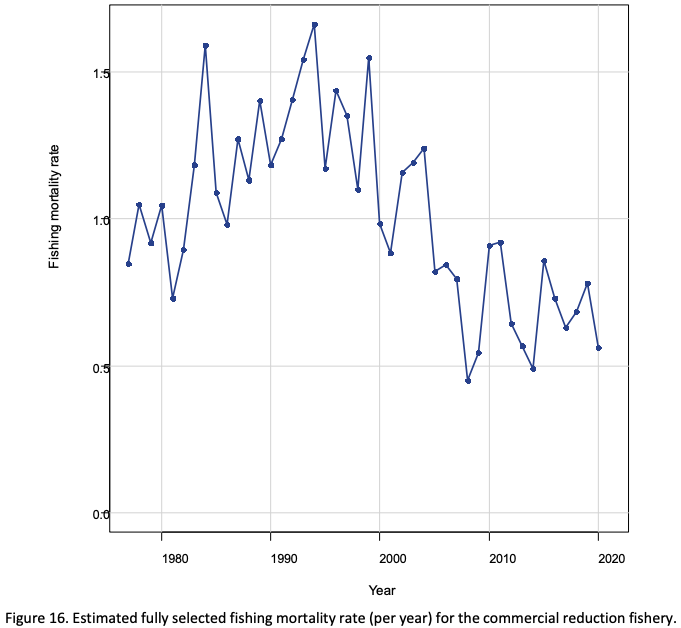
Gulf menhaden has been internationally recognized as a sustainable fishery. Since 2019, the fishery has been certified as sustainable by the Marine Stewardship Council (MSC), the most prominent international seafood certification program. Much like this assessment, the MSC certification cited the long-term health of the menhaden population, as well as noting the limited environmental impact of the fishery.
About the MFC
The Menhaden Fisheries Coalition (MFC) is a collective of menhaden fishermen, related businesses, and supporting industries. Comprised of businesses along the Atlantic and Gulf coasts, the Menhaden Fisheries Coalition conducts media and public outreach on behalf of the menhaden industry to ensure that members of the public, media, and government are informed of important issues, events, and facts about the fishery.
New Analysis Shows Minuscule Impact of Fishing on Atlantic Menhaden
WASHINGTON, DC / August 3, 2020
As the Atlantic States Marine Fisheries Commission (ASMFC) considers whether to adopt Ecological Reference Points for Atlantic menhaden at its Summer Meeting this week, a new scientific analysis confirms that current management is working, and that the fishery has a minuscule impact on the overall menhaden population.
WASHINGTON, DC / August 3, 2020 / As the Atlantic States Marine Fisheries Commission (ASMFC) considers whether to adopt Ecological Reference Points for Atlantic menhaden at its Summer Meeting this week, a new scientific analysis confirms that current management is working, and that the fishery has a minuscule impact on the overall menhaden population.
The review, conducted by prominent fisheries scientist Dr. Steve Cadrin of the University of Massachusetts Dartmouth at the request of the Science Center for Marine Fisheries (SCEMFIS), found that 99.5 percent of menhaden born each year are left in the water, where they serve as forage for other species and fulfill other ecological roles. Just 0.5 percent of menhaden are harvested by either the reduction or bait fishery.

Especially notable in the review's findings was the fact that the menhaden fishery harvests very few menhaden under the age of 2, which are the ages at which menhaden are most likely to be consumed by predators. The fishery also rarely harvests older fish that are important for menhaden spawning.
Analyzing a decade's worth of the most recent data, from 2008-2017, the review indicated that current menhaden harvest levels are extremely precautionary, and that current management is already doing a good job of protecting the ecosystem.
"This review confirms that menhaden management is working for the fishery, the resource, and the environment," said Wayne Reichle, President of Lund's Fisheries, a Menhaden Fisheries Coalition member based in Cape May, New Jersey. "The Commission should consider these results while they debate Ecological Reference Points, and before they consider any adjustments to the current menhaden harvest levels."
In addition to demonstrating the minimal impact of the fishery on the larger menhaden population, the report also noted that the overall biomass for menhaden is "almost the highest on record," while similarly noting that fishing mortality is "much less than historical levels, much less than the management reference points, and much less than the rate of natural mortality," part of a trend towards lower mortality and higher biomass that began in the 1990s.
The healthy indicators for the menhaden fishery are in stark contrast to other species, specifically striped bass, which are considered to be overfished. Based on the available evidence from the most recent menhaden assessment, it is unlikely that current issues facing striped bass are a result of insufficient menhaden, given the near-historically high levels of menhaden abundance and low levels of fishing mortality.
The menhaden fishery is also certified sustainable by the Marine Stewardship Council, the preeminent fisheries sustainability certification body.
Dr. Cadrin's review is part of an overwhelming body of evidence that the menhaden fishery is sustainable and current menhaden management is successful. The Commission should not forget this success as it considers the fishery's future.
About the MFC
The Menhaden Fisheries Coalition (MFC) is a collective of menhaden fishermen, related businesses, and supporting industries. Comprised of businesses along the Atlantic and Gulf coasts, the Menhaden Fisheries Coalition conducts media and public outreach on behalf of the menhaden industry to ensure that members of the public, media, and government are informed of important issues, events, and facts about the fishery.
Menhaden Fisheries Coalition Responds to Inaccuracies in Osprey Story from "The SandPaper"
WASHINGTON, DC / October 9, 2025
The Menhaden Fisheries Coalition (MFC) is calling out an error-laden article published by The SandPaper, a newsmagazine based in Long Beach Island, New Jersey, titled "Menhaden Scarcity Leads to Bleak Outlook for Ospreys." The article is factually inaccurate, journalistically unbalanced, and overtly reliant on unsupported claims from a single advocacy group. MFC has repeatedly contacted The SandPaper's managing editor Jay Mann asking for corrections, but unfortunately, Mr. Mann has ignored our requests.
WASHINGTON, DC / October 9, 2025 / The Menhaden Fisheries Coalition (MFC) is calling out an error-laden article published by The SandPaper, a newsmagazine based in Long Beach Island, New Jersey, titled "Menhaden Scarcity Leads to Bleak Outlook for Ospreys." The article is factually inaccurate, journalistically unbalanced, and overtly reliant on unsupported claims from a single advocacy group. MFC has repeatedly contacted The SandPaper's managing editor Jay Mann asking for corrections, but unfortunately, Mr. Mann has ignored our requests.
It is difficult to determine whether the article, written by Juliet Kaszas-Hoch, represents an effort at objective journalism or a promotional fundraising appeal on behalf of the Conserve Wildlife Foundation of New Jersey. Either way, it is riddled with factual errors, misleading insinuations, and one-sided narratives.
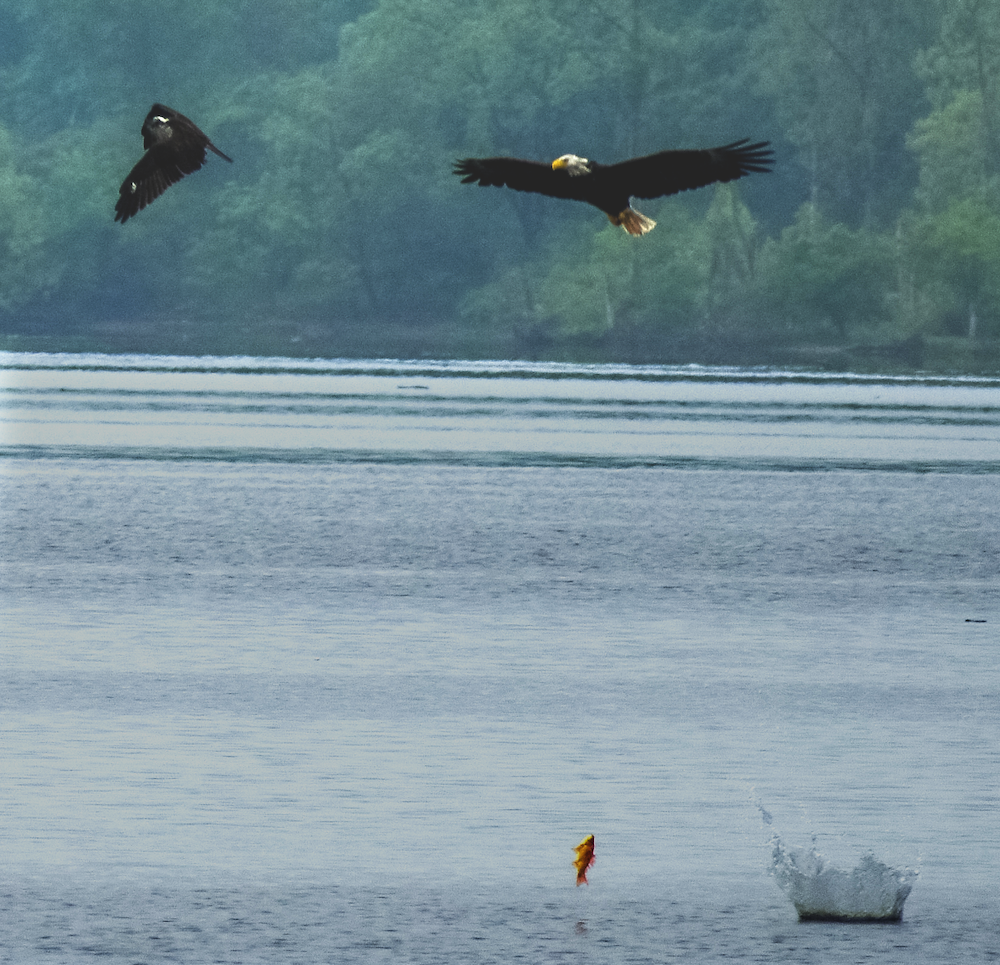
A bald eagle forces an osprey to relinquish its prey (Photo: Robert Blanton)
Key Omissions and Misrepresentations
The article failed to seek or include perspectives from the menhaden fishing industry. Numerous public statements, scientific reports, and contact listings are readily available online, yet no effort was made to reach out for balance or fact-checking. Instead, the piece relies almost exclusively on speculative commentary from nonprofit advocates.
Among the key factual clarifications:
No "dramatic decrease" in menhaden numbers: The article opens by stating that there has been a "dramatic decrease in numbers of menhaden…in the Atlantic Ocean." There is no scientific evidence to support this claim. The Atlantic States Marine Fisheries Commission (ASMFC), the interstate body that manages menhaden, has repeatedly found the species is not overfished and overfishing is not occurring. The fishery is certified sustainable by the Marine Stewardship Council, the international gold standard for seafood sustainability.
U.S. Vessels and Workers: While the article notes Omega Protein's relationship with Ocean Harvesters, it fails to clarify that Ocean Harvesters is a U.S.-based company employing American citizens, not Canadians. The claim that "two-thirds of the total amount of catch for the entire Atlantic coast is being removed by a Canadian company" is false. The menhaden fishing fleet is American-crewed, American-flagged, unionized (represented by UFCW Local 400), and primarily owned by U.S. stakeholders.
Osprey Populations and Scientific Findings: The article's central claim-that a lack of menhaden is causing osprey populations to collapse-is not supported by scientific consensus. It selectively quotes individuals while ignoring a May 2025 letter to Congress from the U.S. Geological Survey (USGS), which explained that osprey reproductive challenges are due to a range of ecological stressors, including weather, interspecies competition, and prey access. The USGS has found no direct link between the menhaden harvest and osprey nesting failures. In a recent Associated Press video, Dr. Dr. Bryan Watts, the same scientist cited in the article, stated that additional research is needed to determine whether climate change may be contributing to the trend.
No Evidence of Localized Depletion: The article recycles the unsubstantiated theory of "localized depletion" of menhaden in nearshore areas. Yet peer-reviewed stock assessments by ASMFC have found no evidence of localized depletion. Menhaden harvests occur primarily offshore and are tightly regulated under Ecological Reference Points (ERPs) designed to maintain balance between prey species and predator needs.
Slogan ≠ Science: The article repeats the oft-used phrase that menhaden are "the most important fish in the sea," a line from a book by Rutgers historian H. Bruce Franklin. While catchy, this is a rhetorical device, not a scientific conclusion. In reality, predator species depend on a diverse range of forage fish-including bay anchovy, herring, and sand lance-depending on geography, season, and biology.
A Call for Responsible Journalism
The Menhaden Fisheries Coalition urges The SandPaper to correct the factual errors and offer balanced coverage that includes the voices of those in sustainable commercial fishing-many of them unionized, based in New Jersey and Virginia, and actively engaged in conserving the resource.
To uncritically elevate activist slogans while ignoring science and failing to contact the fishing community is a disservice to readers and an abdication of journalistic responsibility.
About the Menhaden Fisheries Coalition
The Menhaden Fisheries Coalition (MFC) is a collective of menhaden fishermen, related businesses, and supporting industries. Comprised of businesses along the Atlantic and Gulf coasts, the Menhaden Fisheries Coalition conducts media and public outreach on behalf of the menhaden industry to ensure that members of the public, media, and government are informed of important issues, events, and facts about the fishery.